What Were the Years Justinian Ruled Art and Architecture in the Age of Justinian
| Justinian I | |||||
|---|---|---|---|---|---|
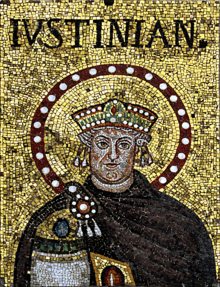
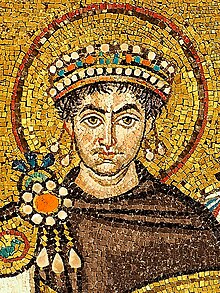 Item of a contemporary portrait mosaic in the Basilica of San Vitale, Ravenna | |||||
| Byzantine emperor | |||||
| Augustus | 1 Apr 527 – 14 Nov 565 (alone from one August 527) | ||||
| Acclamatio | one April 527 | ||||
| Predecessor | Justin I | ||||
| Successor | Justin 2 | ||||
| Born | Petrus Sabbatius 482 Tauresium, Dardania (now North Macedonia[1]) | ||||
| Died | fourteen November 565 (aged 83) Great Palace of Constantinople, Constantinople | ||||
| Burying | Church building of the Holy Apostles, Constantinople | ||||
| Spouse | Theodora | ||||
| |||||
| Dynasty | Justinian dynasty | ||||
| Male parent |
| ||||
| Mother | Vigilantia | ||||
| Organized religion | Chalcedonian Christianity | ||||
Justinian I (; Latin: Flavius Petrus Sabbatius Iustinianus; Greek: Ἰουστινιανός Ioustinianos ; 482 – 14 November 565), also known equally Justinian the Great, was the Byzantine emperor from 527 to 565.
His reign is marked by the ambitious only only partly realized renovatio imperii, or "restoration of the Empire".[2] This ambition was expressed by the partial recovery of the territories of the defunct Western Roman Empire.[3] His general, Belisarius, swiftly conquered the Vandal Kingdom in North Africa. After, Belisarius, Narses, and other generals conquered the Ostrogothic kingdom, restoring Dalmatia, Sicily, Italy, and Rome to the empire after more than half a century of rule by the Ostrogoths. The praetorian prefect Liberius reclaimed the south of the Iberian peninsula, establishing the province of Spania. These campaigns re-established Roman control over the western Mediterranean, increasing the Empire's annual revenue by over a million solidi.[iv] During his reign, Justinian likewise subdued the Tzani, a people on the east declension of the Blackness Sea that had never been nether Roman dominion earlier.[5] He engaged the Sasanian Empire in the east during Kavad I's reign, and later once more during Khosrow I'south; this second conflict was partially initiated due to his ambitions in the west.
A still more than resonant aspect of his legacy was the uniform rewriting of Roman law, the Corpus Juris Civilis, which is still the footing of civil law in many modern states.[vi] His reign also marked a blossoming of Byzantine culture, and his edifice program yielded works such as the Hagia Sophia. He is called "Saint Justinian the Emperor" in the Eastern Orthodox Church.[vii] Because of his restoration activities, Justinian has sometimes been known every bit the "Last Roman" in mid-20th century historiography.[viii]
Life [edit]

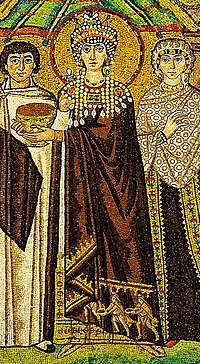
Mosaic of Theodora
Justinian was born in Tauresium,[9] Dardania,[ten] effectually 482. A native speaker of Latin (possibly the last Roman emperor to exist one),[11] he came from a peasant family believed to take been of Illyro-Roman[12] [thirteen] [14] or of Thraco-Roman[fifteen] [16] [17] origin. The cognomen Iustinianus, which he took later, is indicative of adoption past his uncle Justin.[18] During his reign, he founded Justiniana Prima not far from his birthplace.[xix] [twenty] [21] His female parent was Vigilantia, the sister of Justin. Justin, who was commander of one of the purple baby-sit units (the Excubitors) before he became emperor,[22] adopted Justinian, brought him to Constantinople, and ensured the boy'south education.[22] As a result, Justinian was well educated in jurisprudence, theology and Roman history.[22] Justinian served as a candidatus, 1 of 40 men selected from the scholae palatinae to serve every bit the emperor'southward personal bodyguard.[23] The chronicler John Malalas, who lived during the reign of Justinian, describes his appearance as brusk, off-white skinned, curly haired, round faced and handsome. Another gimmicky historian, Procopius, compares Justinian's appearance to that of tyrannical Emperor Domitian, although this is probably slander.[24]
When Emperor Anastasius died in 518, Justin was proclaimed the new emperor, with significant help from Justinian.[22] During Justin's reign (518–527), Justinian was the emperor'south close confidant. Justinian showed a lot of ambition, and it has been idea that he was performance as virtual regent long before Justin fabricated him associate emperor on 1 April 527,[25] although there is no conclusive evidence of this.[26] As Justin became senile virtually the end of his reign, Justinian became the de facto ruler.[22] Post-obit the general Vitalian'due south assassination presumed to be orchestrated past Justinian or Justin, Justinian was appointed delegate in 521 and later commander of the army of the e.[22] [27] Upon Justin's death on one August 527, Justinian became the sole sovereign.[25]
As a ruler, Justinian showed great energy. He was known as "the emperor who never sleeps" for his work habits. Yet, he seems to have been affable and easy to approach.[28] Effectually 525, he married his mistress, Theodora, in Constantinople. She was past profession an actress and some twenty years his junior. In earlier times, Justinian could non have married her owing to her class, just his uncle, Emperor Justin I, had passed a law lifting restrictions on marriages with ex-actresses.[29] [30] Though the marriage caused a scandal, Theodora would get very influential in the politics of the Empire. Other talented individuals included Tribonian, his legal adviser; Peter the Patrician, the diplomat and long-time caput of the palace hierarchy; Justinian's finance ministers John the Cappadocian and Peter Barsymes, who managed to collect taxes more efficiently than any before, thereby funding Justinian's wars; and finally, his prodigiously talented generals, Belisarius and Narses.
Justinian's rule was non universally popular; early in his reign he nearly lost his throne during the Nika riots, and a conspiracy against the emperor'due south life by dissatisfied businessmen was discovered as late as 562.[31] Justinian was struck by the plague in the early 540s but recovered. Theodora died in 548[32] at a relatively young age, perchance of cancer; Justinian outlived her by nearly twenty years. Justinian, who had ever had a bang-up interest in theological matters and actively participated in debates on Christian doctrine,[33] became even more devoted to faith during the afterwards years of his life. He died on 14 November 565,[34] childless. He was succeeded past Justin II, who was the son of his sister Vigilantia and married to Sophia, the niece of Theodora. Justinian's torso was entombed in a peculiarly built mausoleum in the Church of the Holy Apostles until it was desecrated and robbed during the pillage of the city in 1204 by the Latin States of the Fourth Cause.[35]
Reign [edit]
Legislative activities [edit]
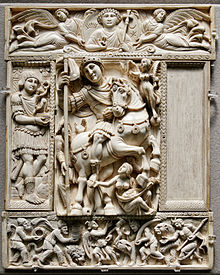
Justinian accomplished lasting fame through his judicial reforms, peculiarly through the complete revision of all Roman law,[36] something that had not previously been attempted. The total of Justinian's legislation is known today as the Corpus juris civilis. It consists of the Codex Justinianeus, the Digesta or Pandectae, the Institutiones, and the Novellae.
Early in his reign, Justinian had appointed the quaestor Tribonian to oversee this chore. The outset draft of the Codex Justinianeus, a codification of regal constitutions from the 2d century onward, was issued on 7 April 529. (The final version appeared in 534.) It was followed by the Digesta (or Pandectae), a compilation of older legal texts, in 533, and past the Institutiones, a textbook explaining the principles of constabulary. The Novellae, a collection of new laws issued during Justinian's reign, supplements the Corpus. As opposed to the remainder of the corpus, the Novellae appeared in Greek, the common language of the Eastern Empire.
The Corpus forms the basis of Latin jurisprudence (including ecclesiastical Canon Law) and, for historians, provides a valuable insight into the concerns and activities of the later Roman Empire. Every bit a collection it gathers together the many sources in which the leges (laws) and the other rules were expressed or published: proper laws, senatorial consults (senatusconsulta), imperial decrees, case law, and jurists' opinions and interpretations (responsa prudentium). Tribonian's code ensured the survival of Roman police force. It formed the ground of later Byzantine constabulary, equally expressed in the Basilika of Basil I and Leo VI the Wise. The only western province where the Justinianic code was introduced was Italy (after the conquest past the so-called Pragmatic Sanction of 554),[37] from where it was to pass to Western Europe in the 12th century and become the basis of much Continental European law lawmaking, which somewhen was spread by European empires to the Americas and beyond in the Historic period of Discovery. Information technology eventually passed to Eastern Europe where it appeared in Slavic editions, and it too passed on to Russia.[38] It remains influential to this solar day.
He passed laws to protect prostitutes from exploitation and women from being forced into prostitution. Rapists were treated severely. Further, by his policies: women charged with major crimes should be guarded by other women to forbid sexual abuse; if a woman was widowed, her dowry should be returned; and a husband could not have on a major debt without his married woman giving her consent twice.[39]
Justinian discontinued the regular date of Consuls in 541.[40]
Nika riots [edit]
Justinian's addiction of choosing efficient, just unpopular advisers nearly cost him his throne early on in his reign. In January 532, partisans of the chariot racing factions in Constantinople, usually rivals, united confronting Justinian in a revolt that has become known as the Nika riots. They forced him to dismiss Tribonian and two of his other ministers, and and then attempted to overthrow Justinian himself and supplant him with the senator Hypatius, who was a nephew of the tardily emperor Anastasius. While the oversupply was rioting in the streets, Justinian considered fleeing the capital by sea, only eventually decided to stay, apparently on the prompting of his married woman Theodora, who refused to leave. In the side by side 2 days, he ordered the brutal suppression of the riots by his generals Belisarius and Mundus. Procopius relates that 30,000[41] unarmed civilians were killed in the Hippodrome. On Theodora'due south insistence, and manifestly against his own judgment,[42] Justinian had Anastasius' nephews executed.[43]
The destruction that took identify during the defection provided Justinian with an opportunity to tie his name to a serial of splendid new buildings, nigh notably the architectural innovation of the domed Hagia Sophia.
War machine activities [edit]
One of the most spectacular features of Justinian'due south reign was the recovery of big stretches of state around the Western Mediterranean basin that had slipped out of Imperial control in the 5th century.[44] As a Christian Roman emperor, Justinian considered it his divine duty to restore the Roman Empire to its ancient boundaries. Although he never personally took role in military campaigns, he boasted of his successes in the prefaces to his laws and had them commemorated in art.[45] The re-conquests were in large role carried out past his full general Belisarius.[n. 1]

War with the Sassanid Empire, 527–532 [edit]
From his uncle, Justinian inherited ongoing hostilities with the Sassanid Empire.[46] In 530 the Farsi forces suffered a double defeat at Dara and Satala, but the next year saw the defeat of Roman forces under Belisarius nearly Callinicum.[47] Justinian then tried to brand alliance with the Axumites of Ethiopia and the Himyarites of Republic of yemen against the Persians, simply this failed.[48] When king Kavadh I of Persia died (September 531), Justinian concluded an "Eternal Peace" (which cost him 11,000 pounds of gold)[47] with his successor Khosrau I (532). Having thus secured his eastern frontier, Justinian turned his attending to the West, where Germanic kingdoms had been established in the territories of the erstwhile Western Roman Empire.
Conquest of Northward Africa, 533–534 [edit]
The first of the western kingdoms Justinian attacked was that of the Vandals in North Africa. King Hilderic, who had maintained good relations with Justinian and the Northward African Cosmic clergy, had been overthrown by his cousin Gelimer in 530 A.D. Imprisoned, the deposed king appealed to Justinian.
In 533, Belisarius sailed to Africa with a fleet of 92 dromons, escorting 500 transports carrying an army of about 15,000 men, equally well as a number of barbarian troops. They landed at Head Vada (modern Ras Kaboudia) in mod Tunisia. They defeated the Vandals, who were defenseless completely off guard, at Advertisement Decimum on xiv September 533 and Tricamarum in December; Belisarius took Carthage. King Gelimer fled to Mountain Pappua in Numidia, but surrendered the next leap. He was taken to Constantinople, where he was paraded in a triumph. Sardinia and Corsica, the Balearic Islands, and the stronghold Septem Fratres well-nigh Gibraltar were recovered in the same entrada.[49]
In this war, the gimmicky Procopius remarks that Africa was so entirely depopulated that a person might travel several days without meeting a human being, and he adds, "it is no exaggeration to say, that in the form of the war five,000,000 perished past the sword, and famine, and pestilence."
An African prefecture, centered in Carthage, was established in April 534,[50] only information technology would teeter on the brink of collapse during the side by side 15 years, amidst warfare with the Moors and military mutinies. The area was not completely pacified until 548,[51] simply remained peaceful thereafter and enjoyed a measure out of prosperity. The recovery of Africa cost the empire nigh 100,000 pounds of golden.[52]
War in Italy, first phase, 535–540 [edit]

As in Africa, dynastic struggles in Ostrogothic Italy provided an opportunity for intervention. The young rex Athalaric had died on ii October 534, and a usurper, Theodahad, had imprisoned queen Amalasuintha, Theodoric's daughter and mother of Athalaric, on the island of Martana in Lake Bolsena, where he had her assassinated in 535. Thereupon Belisarius, with 7,500 men,[53] invaded Sicily (535) and advanced into Italian republic, sacking Naples and capturing Rome on 9 December 536. By that time Theodahad had been deposed by the Ostrogothic army, who had elected Vitigis equally their new king. He gathered a large ground forces and besieged Rome from February 537 to March 538 without existence able to retake the metropolis.
Justinian sent another general, Narses, to Italy, only tensions between Narses and Belisarius hampered the progress of the campaign. Milan was taken, but was soon recaptured and razed past the Ostrogoths. Justinian recalled Narses in 539. Past then the military machine situation had turned in favour of the Romans, and in 540 Belisarius reached the Ostrogothic upper-case letter Ravenna. At that place he was offered the title of Western Roman Emperor past the Ostrogoths at the same fourth dimension that envoys of Justinian were arriving to negotiate a peace that would leave the region north of the Po River in Gothic easily. Belisarius feigned credence of the offer, entered the city in May 540, and reclaimed it for the Empire.[54] And so, having been recalled past Justinian, Belisarius returned to Constantinople, taking the captured Vitigis and his wife Matasuntha with him.
War with the Sassanid Empire, 540–562 [edit]

A golden medallion celebrating the reconquest of Africa, AD 534
Belisarius had been recalled in the face of renewed hostilities past the Persians. Post-obit a defection confronting the Empire in Armenia in the late 530s and possibly motivated by the pleas of Ostrogothic ambassadors, Rex Khosrau I broke the "Eternal Peace" and invaded Roman territory in the jump of 540.[55] He starting time sacked Beroea and so Antioch (assuasive the garrison of six,000 men to leave the metropolis),[56] besieged Daras, and then went on to assail the small but strategically significant satellite kingdom of Lazica near the Black Sea, exacting tribute from the towns he passed forth his manner. He forced Justinian I to pay him 5,000 pounds of aureate, plus 500 pounds of gilt more each year.[56]
Belisarius arrived in the E in 541, only after some success, was once again recalled to Constantinople in 542. The reasons for his withdrawal are not known, but it may have been instigated by rumours of his disloyalty reaching the court.[57] The outbreak of the plague caused a lull in the fighting during the year 543. The following twelvemonth Khosrau defeated a Byzantine ground forces of 30,000 men,[58] but unsuccessfully besieged the major urban center of Edessa. Both parties made little headway, and in 545 a truce was agreed upon for the southern part of the Roman-Persian frontier. Subsequently that the Lazic War in the Northward continued for several years, until a second truce in 557, followed by a Fifty Years' Peace in 562. Under its terms, the Persians agreed to abandon Lazica in exchange for an almanac tribute of 400 or 500 pounds of gold (30,000 solidi) to be paid by the Romans.[59]
War in Italy, second stage, 541–554 [edit]
While military efforts were directed to the East, the situation in Italy took a turn for the worse. Under their respective kings Ildibad and Eraric (both murdered in 541) and specially Totila, the Ostrogoths made quick gains. Afterward a victory at Faenza in 542, they reconquered the major cities of Southern Italia and shortly held almost the unabridged Italian peninsula. Belisarius was sent dorsum to Italy late in 544 just lacked sufficient troops and supplies. Making no headway, he was relieved of his command in 548. Belisarius succeeded in defeating a Gothic fleet of 200 ships.[ citation needed ] During this menstruum the metropolis of Rome inverse easily three more times, first taken and depopulated by the Ostrogoths in Dec 546, then reconquered by the Byzantines in 547, and so once again by the Goths in January 550. Totila besides plundered Sicily and attacked Greek coastlines.

Finally, Justinian dispatched a force of approximately 35,000 men (2,000 men were detached and sent to invade southern Visigothic Hispania) under the command of Narses.[sixty] The ground forces reached Ravenna in June 552 and defeated the Ostrogoths decisively within a month at the battle of Busta Gallorum in the Apennines, where Totila was slain. Subsequently a 2d battle at Mons Lactarius in October that yr, the resistance of the Ostrogoths was finally broken. In 554, a big-scale Frankish invasion was defeated at Casilinum, and Italy was secured for the Empire, though information technology would take Narses several years to reduce the remaining Gothic strongholds. At the end of the war, Italy was garrisoned with an army of 16,000 men.[61] The recovery of Italy toll the empire about 300,000 pounds of gold.[52] Procopius estimated xv,000,000 Goths died.[62]
Other campaigns [edit]

Emperor Justinian reconquered many erstwhile territories of the Western Roman Empire, including Italian republic, Dalmatia, Africa, and southern Hispania.
In add-on to the other conquests, the Empire established a presence in Visigothic Hispania, when the usurper Athanagild requested assistance in his rebellion confronting King Agila I. In 552, Justinian dispatched a force of 2,000 men; according to the historian Jordanes, this army was led past the octogenarian Liberius.[63] The Byzantines took Cartagena and other cities on the southeastern declension and founded the new province of Spania before being checked by their sometime ally Athanagild, who had by now become rex. This entrada marked the apogee of Byzantine expansion.[ citation needed ]
During Justinian'southward reign, the Balkans suffered from several incursions by the Turkic and Slavic peoples who lived north of the Danube. Here, Justinian resorted mainly to a combination of diplomacy and a system of defensive works. In 559 a especially dangerous invasion of Sklavinoi and Kutrigurs nether their khan Zabergan threatened Constantinople, but they were repulsed by the anile general Belisarius.[64]
Results [edit]
Justinian's ambition to restore the Roman Empire to its former glory was just partly realized. In the Due west, the bright early military machine successes of the 530s were followed past years of stagnation. The dragging state of war with the Goths was a disaster for Italy, even though its long-lasting effects may have been less severe than is sometimes thought.[65] The heavy taxes that the assistants imposed upon its population were deeply resented.
The final victory in Italy and the conquest of Africa and the declension of southern Hispania significantly enlarged the area of Byzantine influence and eliminated all naval threats to the empire, which in 555 reached its territorial zenith. Despite losing much of Italy soon after Justinian'due south death, the empire retained several important cities, including Rome, Naples, and Ravenna, leaving the Lombards as a regional threat. The newly founded province of Spania kept the Visigoths as a threat to Hispania alone and not to the western Mediterranean and Africa.
Events of the later years of his reign showed that Constantinople itself was not safe from barbarian incursions from the north, and fifty-fifty the relatively benevolent historian Menander Protector felt the need to aspect the Emperor's failure to protect the capital to the weakness of his trunk in his old historic period.[66] In his efforts to renew the Roman Empire, Justinian dangerously stretched its resource while failing to take into business relationship the changed realities of 6th-century Europe.[67]
Religious activities [edit]
| Saint Justinian the Great | |
|---|---|
 Illustration of an angel showing Justinian a model of Hagia Sophia in a vision, by Herbert Cole (1912) | |
| Emperor | |
| Venerated in |
|
| Major shrine | Church of the Holy Apostles, Constantinople mod day Istanbul, Turkey |
| Feast | 14 November |
| Attributes | Imperial Vestment |

Justinian I, depicted on an AE Follis money
Justinian saw the orthodoxy of his empire threatened by diverging religious currents, especially Monophysitism, which had many adherents in the eastern provinces of Syria and Arab republic of egypt. Monophysite doctrine, which maintains that Jesus Christ had one divine nature rather than a synthesis of divine and human nature, had been condemned equally a heresy by the Council of Chalcedon in 451, and the tolerant policies towards Monophysitism of Zeno and Anastasius I had been a source of tension in the relationship with the bishops of Rome. Justin reversed this tendency and confirmed the Chalcedonian doctrine, openly condemning the Monophysites. Justinian, who continued this policy, tried to impose religious unity on his subjects by forcing them to have doctrinal compromises that might entreatment to all parties, a policy that proved unsuccessful equally he satisfied none of them.[68]
Near the stop of his life, Justinian became ever more inclined towards the Monophysite doctrine, especially in the course of Aphthartodocetism, only he died before being able to event any legislation. The empress Theodora sympathized with the Monophysites and is said to have been a constant source of pro-Monophysite intrigues at the courtroom in Constantinople in the before years. In the class of his reign, Justinian, who had a genuine interest in matters of theology, authored a small number of theological treatises.[69]
Religious policy [edit]

Hagia Sophia mosaic depicting the Virgin Mary holding the Child Christ on her lap. On her right side stands Justinian, offering a model of the Hagia Sophia. On her left, Constantine I presents a model of Constantinople.
As in his secular administration, despotism appeared also in the Emperor's ecclesiastical policy. He regulated everything, both in faith and in police.

At the very beginning of his reign, he deemed information technology proper to promulgate by law the Church's belief in the Trinity and the Incarnation, and to threaten all heretics with the appropriate penalties,[70] whereas he subsequently declared that he intended to deprive all disturbers of orthodoxy of the opportunity for such offense by due procedure of constabulary.[71] He made the Nicaeno-Constantinopolitan creed the sole symbol of the Church[72] and accorded legal forcefulness to the canons of the four ecumenical councils.[73] The bishops in omnipresence at the Council of Constantinople (536) recognized that nothing could be washed in the Church contrary to the emperor'south will and command,[74] while, on his side, the emperor, in the case of the Patriarch Anthimus, reinforced the ban of the Church building with temporal proscription.[75] Justinian protected the purity of the church by suppressing heretics. He neglected no opportunity to secure the rights of the Church and clergy, and to protect and extend monasticism. He granted the monks the right to inherit property from private citizens and the correct to receive solemnia, or annual gifts, from the Imperial treasury or from the taxes of sure provinces and he prohibited lay confiscation of monastic estates.
Although the despotic character of his measures is contrary to modernistic sensibilities, he was indeed a "nursing father" of the Church. Both the Codex and the Novellae contain many enactments regarding donations, foundations, and the administration of ecclesiastical property; election and rights of bishops, priests and abbots; monastic life, residential obligations of the clergy, deport of divine service, episcopal jurisdiction, etc. Justinian also rebuilt the Church building of Hagia Sophia (which cost xx,000 pounds of aureate),[76] the original site having been destroyed during the Nika riots. The new Hagia Sophia, with its numerous chapels and shrines, gilded octagonal dome, and mosaics, became the centre and most visible monument of Eastern Orthodoxy in Constantinople.[ citation needed ]
Religious relations with Rome [edit]
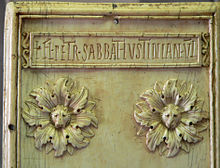
Consular diptych displaying Justinian'southward full name (Constantinople 521)
From the middle of the 5th century onward, increasingly backbreaking tasks confronted the emperors of the East in ecclesiastical matters. Justinian entered the arena of ecclesiastical statecraft shortly after his uncle's accession in 518, and put an end to the Acacian schism. Previous Emperors had tried to alleviate theological conflicts by declarations that deemphasized the Council of Chalcedon, which had condemned Monophysitism, which had strongholds in Egypt and Syrian arab republic, and by tolerating the date of Monophysites to church offices. The Popes reacted by severing ties with the Patriarch of Constantinople who supported these policies. Emperors Justin I (and later Justinian himself) rescinded these policies and reestablished the union between Constantinople and Rome.[77] After this, Justinian too felt entitled to settle disputes in papal elections, as he did when he favoured Vigilius and had his rival Silverius deported.
This new-found unity between East and West did non, still, solve the ongoing disputes in the e. Justinian's policies switched betwixt attempts to force Monophysites and Miaphysites (who were mistaken to be adherers of Monophysitism) to accept the Chalcedonian creed by persecuting their bishops and monks – thereby embittering their sympathizers in Egypt and other provinces – and attempts at a compromise that would win over the Monophysites without surrendering the Chalcedonian organized religion. Such an approach was supported by the Empress Theodora, who favoured the Miaphysites unreservedly. In the condemnation of the Three Chapters, three theologians that had opposed Monophysitism before and after the Council of Chalcedon, Justinian tried to win over the opposition. At the Fifth Ecumenical Quango, nigh of the Eastern church yielded to the Emperor's demands, and Pope Vigilius, who was forcibly brought to Constantinople and besieged at a chapel, finally also gave his assent. However, the condemnation was received unfavourably in the w, where it led to new (albeit temporal) schism, and failed to achieve its goal in the east, as the Monophysites remained unsatisfied – all the more bitter for him because during his last years he took an fifty-fifty greater interest in theological matters.
[edit]

Justinian was one of the first Roman Emperors to be depicted holding the cross-surmounted orb on the obverse of a coin.
Justinian'south religious policy reflected the Imperial confidence that the unity of the Empire presupposed unity of faith, and information technology appeared to him obvious that this faith could only exist the orthodoxy (Chalcedonian). Those of a different belief were subjected to persecution, which purple legislation had effected from the time of Constantius II and which would now vigorously continue. The Codex contained two statutes[78] that decreed the total devastation of paganism, even in private life; these provisions were zealously enforced. Contemporary sources (John Malalas, Theophanes, and John of Ephesus) tell of severe persecutions, even of men in high position.[ dubious ]
The original Academy of Plato had been destroyed by the Roman dictator Sulla in 86 BC. Several centuries subsequently, in 410 AD, a Neoplatonic University was established that had no institutional continuity with Plato's Academy, and which served as a centre for Neoplatonism and mysticism. It persisted until 529 AD when it was finally closed by Justinian I. Other schools in Constantinople, Antioch, and Alexandria, which were the centers of Justinian's empire, connected.[79]
In Asia Minor solitary, John of Ephesus was reported to have converted 70,000 pagans, which was probably an exaggerated number.[80] Other peoples as well accepted Christianity: the Heruli,[81] the Huns home near the Don,[82] the Abasgi,[83] and the Tzanni in Caucasia.[84]
The worship of Amun at the haven of Awjila in the Libyan desert was abolished,[85] and then were the remnants of the worship of Isis on the island of Philae, at the first cataract of the Nile.[86] The Presbyter Julian[87] and the Bishop Longinus[88] conducted a mission among the Nabataeans, and Justinian attempted to strengthen Christianity in Republic of yemen by dispatching a bishop from Egypt.[89]
The civil rights of Jews were restricted[xc] and their religious privileges threatened.[91] Justinian also interfered in the internal diplomacy of the synagogue[92] and encouraged the Jews to use the Greek Septuagint in their synagogues in Constantinople.[93]
The Emperor faced significant opposition from the Samaritans, who resisted conversion to Christianity and were repeatedly in insurrection. He persecuted them with rigorous edicts, but could not prevent reprisals towards Christians from taking place in Samaria toward the close of his reign. The consistency of Justinian'south policy meant that the Manicheans too suffered persecution, experiencing both exile and threat of death sentence.[94] At Constantinople, on one occasion, not a few Manicheans, later on strict inquisition, were executed in the emperor's very presence: some by called-for, others past drowning.[95]
Architecture, learning, art and literature [edit]
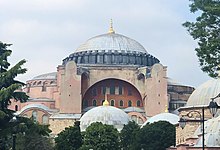
The church of Hagia Sophia was built at the fourth dimension of Justinian.
Justinian was a prolific architect; the historian Procopius bears witness to his activities in this surface area.[96] Under Justinian'south reign, the San Vitale in Ravenna, which features ii famous mosaics representing Justinian and Theodora, was completed under the sponsorship of Julius Argentarius.[22] Most notably, he had the Hagia Sophia, originally a basilica-manner church that had been burnt downwardly during the Nika riots, splendidly rebuilt co-ordinate to a completely unlike ground program, nether the architectural supervision of Isidore of Miletus and Anthemius of Tralles. According to Pseudo-Codinus, Justinian stated at the completion of this building, "Solomon, I take outdone thee" (in reference to the showtime Jewish temple). This new cathedral, with its magnificent dome filled with mosaics, remained the centre of eastern Christianity for centuries.[ citation needed ]

Another prominent church building in the capital letter, the Church of the Holy Apostles, which had been in a very poor state near the end of the 5th century, was likewise rebuilt.[97] The Church of Saints Sergius and Bacchus, after renamed Niggling Hagia Sophia, was also built between 532 and 536 past the royal couple.[98] Works of embellishment were not confined to churches solitary: excavations at the site of the Great Palace of Constantinople accept yielded several loftier-quality mosaics dating from Justinian's reign, and a column topped past a bronze statue of Justinian on horseback and dressed in a armed services costume was erected in the Augustaeum in Constantinople in 543.[99] Rivalry with other, more than established patrons from the Constantinopolitan and exiled Roman elite might have enforced Justinian'due south building activities in the capital as a means of strengthening his dynasty'south prestige.[100]
Justinian likewise strengthened the borders of the Empire from Africa to the East through the construction of fortifications and ensured Constantinople of its h2o supply through structure of underground cisterns (see Basilica Cistern). To forbid floods from dissentious the strategically important border boondocks Dara, an advanced arch dam was built. During his reign the large Sangarius Bridge was built in Bithynia, securing a major military supply route to the east. Furthermore, Justinian restored cities damaged by earthquake or war and built a new city near his identify of nativity chosen Justiniana Prima, which was intended to replace Thessalonica every bit the political and religious centre of Illyricum.
In Justinian'southward reign, and partly under his patronage, Byzantine culture produced noteworthy historians, including Procopius and Agathias, and poets such as Paul the Silentiary and Romanus the Melodist flourished. On the other hand, centres of learning such as the Neoplatonic Academy in Athens and the famous Law School of Berytus[101] lost their importance during his reign.[ commendation needed ]
Economic system and administration [edit]
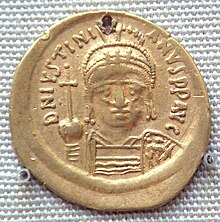
Gold money of Justinian I (527–565) excavated in Bharat probably in the south, an instance of Indo-Roman trade during the period
As was the case under Justinian's predecessors, the Empire's economical wellness rested primarily on agriculture. In addition, long-distance merchandise flourished, reaching as far north every bit Cornwall where can was exchanged for Roman wheat.[102] Within the Empire, convoys sailing from Alexandria provided Constantinople with wheat and grains. Justinian made the traffic more than efficient by building a large granary on the isle of Tenedos for storage and farther transport to Constantinople.[103] Justinian also tried to find new routes for the eastern trade, which was suffering badly from the wars with the Persians.
1 important luxury production was silk, which was imported and and then candy in the Empire. In order to protect the manufacture of silk products, Justinian granted a monopoly to the imperial factories in 541.[104] In club to bypass the Persian landroute, Justinian established friendly relations with the Abyssinians, whom he wanted to act as trade mediators by transporting Indian silk to the Empire; the Abyssinians, however, were unable to compete with the Persian merchants in India.[105] And then, in the early on 550s, two monks succeeded in smuggling eggs of silk worms from Central Asia back to Constantinople,[106] and silk became an indigenous product.
Gold and silver were mined in the Balkans, Anatolia, Armenia, Republic of cyprus, Arab republic of egypt and Nubia.[107]
At the get-go of Justinian I's reign he had inherited a surplus 28,800,000 solidi (400,000 pounds of gold) in the imperial treasury from Anastasius I and Justin I.[52] Under Justinian's rule, measures were taken to counter corruption in the provinces and to make taxation collection more than efficient. Greater administrative power was given to both the leaders of the prefectures and of the provinces, while power was taken abroad from the vicariates of the dioceses, of which a number were abolished. The overall tendency was towards a simplification of administrative infrastructure.[108] Co-ordinate to Brown (1971), the increased professionalization of tax drove did much to destroy the traditional structures of provincial life, every bit it weakened the autonomy of the town councils in the Greek towns.[109] It has been estimated that before Justinian I'southward reconquests the state had an annual revenue of five,000,000 solidi in Advertisement 530, but after his reconquests, the annual revenue was increased to 6,000,000 solidi in Advert 550.[52]
Throughout Justinian's reign, the cities and villages of the East prospered, although Antioch was struck by 2 earthquakes (526, 528) and sacked and evacuated past the Persians (540). Justinian had the city rebuilt, only on a slightly smaller scale.[110]
Despite all these measures, the Empire suffered several major setbacks in the course of the 6th century. The showtime ane was the plague, which lasted from 541 to 543 and, by decimating the Empire'southward population, probably created a scarcity of labor and a rising of wages.[111] The lack of manpower besides led to a meaning increase in the number of "barbarians" in the Byzantine armies afterward the early on 540s.[112] The protracted war in Italia and the wars with the Persians themselves laid a heavy burden on the Empire's resources, and Justinian was criticized for curtailing the government-run post service, which he limited to merely one eastern route of military importance.[113]
Natural disasters [edit]
During the 530s, information technology seemed to many that God had abandoned the Christian Roman Empire. There were noxious fumes in the air and the Dominicus, while all the same providing daylight, refused to requite much heat. The extreme weather events of 535–536 led to a dearth such as had not been recorded before, affecting both Europe and the Middle East.[114] These events may have been caused by an atmospheric dust veil resulting from a big volcanic eruption.[115] [116]
The historian Procopius recorded in 536 in his work on the Vandalic War "during this year a well-nigh dread portent took place. For the sun gave along its lite without brightness … and it seemed exceedingly like the lord's day in eclipse, for the beams information technology shed were not clear".[117] [118]
The causes of these disasters are not precisely known, only volcanoes at the Rabaul caldera, Lake Ilopango, Krakatoa, or, co-ordinate to a recent finding, in Iceland are suspected,[114] as is an air burst event from a comet fragment. [ citation needed ]
Seven years subsequently in 542, a devastating outbreak of Bubonic Plague, known equally the Plague of Justinian and second simply to Blackness Expiry of the 14th century, killed tens of millions. Justinian and members of his courtroom, physically unaffected by the previous 535–536 famine, were afflicted, with Justinian himself contracting and surviving the pestilence. The impact of this outbreak of plague has recently been disputed, since prove for tens of millions dying is uncertain.[119] [120]
In July 551, the eastern Mediterranean was rocked past the 551 Beirut convulsion, which triggered a tsunami. The combined fatalities of both events likely exceeded xxx,000, with tremors felt from Antioch to Alexandria.[121]
Cultural depictions [edit]

In the Paradiso section of the Divine Comedy , Canto (chapter) Vi, by Dante Alighieri, Justinian I is prominently featured as a spirit residing on the sphere of Mercury. The latter holds in Sky the souls of those whose acts were righteous, however meant to reach fame and award. Justinian's legacy is elaborated on, and he is portrayed every bit a defender of the Christian faith and the restorer of Rome to the Empire. Justinian confesses that he was partially motivated by fame rather than duty to God, which tainted the justice of his rule in spite of his proud accomplishments. In his introduction, "Cesare fui e son Iustinïano" ("Caesar I was, and am Justinian"[123]), his mortal title is contrasted with his immortal soul, to emphasize that "glory in life is ephemeral, while contributing to God'due south glory is eternal", according to Dorothy L. Sayers.[124] Dante too uses Justinian to criticize the factious politics of his 14th Century Italian republic, divided between Ghibellines and Guelphs, in contrast to the unified Italia of the Roman Empire.
Justinian is a major character in the 1938 novel Count Belisarius, by Robert Graves. He is depicted as a jealous and conniving Emperor obsessed with creating and maintaining his own historical legacy.
Justinian appears equally a grapheme in the 1939 time travel novel Lest Darkness Autumn, by L. Sprague de Army camp.
The Glittering Horn: Secret Memoirs of the Court of Justinian was a novel written by Pierson Dixon in 1958 about the court of Justinian.
Justinian occasionally appears in the comic strip Prince Valiant, usually every bit a nemesis of the championship character.
Justinian is played by Innokenty Smoktunovsky in the 1985 Soviet film Primary Russian federation
Historical sources [edit]
Procopius provides the master source for the history of Justinian's reign, but his stance is tainted by a feeling of betrayal when Justinian became more than pragmatic and less idealistic (Justinian and the Later Roman Empire by John W. Barker). He became very bitter towards Justinian and his empress, Theodora.[n. 2] The Syriac relate of John of Ephesus, which survives partially, was used as a source for after chronicles, contributing many boosted details of value. Other sources include the writings of John Malalas, Agathias, John the Lydian, Menander Protector, the Paschal Chronicle, Evagrius Scholasticus, Pseudo-Zacharias Rhetor, Jordanes, the chronicles of Marcellinus Comes and Victor of Tunnuna. Justinian is widely regarded every bit a saint past Orthodox Christians, and is too commemorated past some Lutheran churches on 14 November.[north. 3]
See also [edit]
- Church building of the Nascence in Bethlehem, rebuilt by Justinian
- Flavia gens
- International Roman Law Moot Court
Notes [edit]
- ^ Justinian himself took the field merely once, during a campaign against the Huns in 559, when he was already an former man. This enterprise was largely symbolic and although no boxing was fought, the emperor held a triumphal entry in the capital letter afterwards. (See Browning, R. Justinian and Theodora. London 1971, 193.)
- ^ While he glorified Justinian'due south achievements in his panegyric and his Wars, Procopius also wrote a hostile business relationship, Anekdota (the then-called Secret History), in which Justinian is depicted every bit a cruel, venal, and incompetent ruler.
- ^ In various Eastern Orthodox Churches, including the Orthodox Church in America, Justinian and his empress Theodora are commemorated on the anniversary of his death, xiv November. Some denominations interpret the Julian calendar appointment to 27 November on the Gregorian calendar. The Calendar of Saints of the Lutheran Church–Missouri Synod and the Lutheran Church–Canada also remember Justinian on 14 Nov.
References [edit]
- ^ J. B. Bury (2008) [1889] History of the Later Roman Empire from Arcadius to Irene 2. Cosimo, Inc. ISBN 1605204056, p. seven.
- ^ J. F. Haldon, Byzantium in the seventh century (Cambridge, 2003), 17–19.
- ^ On the western Roman Empire, run across now H. Börm, Westrom (Stuttgart 2013).
- ^ "History 303: Finances nether Justinian". Tulane.edu. Archived from the original on 9 March 2008. Retrieved fourteen November 2012.
- ^ Evans, J. A. Southward., The Historic period of Justinian: the circumstances of imperial power. pp. 93–94
- ^ John Henry Merryman and Rogelio Pérez-Perdomo, The Civil Law Tradition: An Introduction to the Legal Systems of Europe and Latin America, tertiary ed. (Stanford: Stanford Academy Press, 2007), pp. 9–11.
- ^ "St. Justinian the Emperor". Orthodox Church building in America . Retrieved 25 Nov 2017.
- ^ For instance past George Philip Baker (Justinian, New York 1938), or in the Outline of Dandy Books serial (Justinian the Great).
- ^ near Skopje, Due north Macedonia
- ^ Britannica Concise Encyclopedia, Encyclopædia Britannica, Inc., 2008, ISBN 1593394926, p. 1007.
- ^ The Inheritance of Rome, Chris Wickham, Penguin Books Ltd. 2009, ISBN 978-0-670-02098-0 (p. xc). Justinian referred to Latin as his native natural language in several of his laws. Encounter Moorhead (1994), p. 18.
- ^ Michael Maas (2005). The Cambridge Companion to the Age of Justinian. Cambridge Academy Printing. ISBN978-1139826877.
- ^ Treadgold, Warren T. (1997). A history of the Byzantine state and society. Stanford University Press. p. 246. ISBN 978-0-8047-2630-6. Retrieved 12 October 2010.
- ^ Barker, John W. (1966). Justinian and the afterwards Roman Empire. University of Wisconsin Press. p. 75. ISBN978-0-299-03944-8 . Retrieved 28 November 2011.
- ^ Robert Browning (2003). Justinian and Theodora. Gorgias Press. ISBN978-1593330538.
- ^ Shifting Genres in Late Antiquity, Hugh Elton, Geoffrey Greatrex, Ashgate Publishing, Ltd., 2015, ISBN 1472443500, p. 259.
- ^ Pannonia and Upper Moesia: A History of the Eye Danube Provinces of the Roman Empire, András Mócsy, Routledge, 2014, ISBN 1317754255, p. 350.
- ^ The sole source for Justinian's full name, Flavius Petrus Sabbatius Iustinianus (sometimes called Flavius Anicius Iustinianus), are consular diptychs of the year 521 bearing his proper noun.
- ^ Sima One thousand. Cirkovic (2004). The Serbs. Wiley. ISBN978-0631204718.
- ^ Justiniana Prima Site of an early Byzantine urban center located 30 km due south-west of Leskovci in Kosovo. Grove'due south Dictionaries. 2006.
- ^ Byzantine Constantinople: Monuments, Topography and Everyday Life. Brill. 2001. ISBN978-9004116252.
- ^ a b c d e f 1000 Robert Browning. "Justinian I" in Dictionary of the Middle Ages, book Vii (1986).
- ^ Martindale, PLRE II 646
- ^ Cambridge Ancient History p. 65
- ^ a b Chronicon Paschale 527; Theophanes Confessor AM 6019.
- ^ Moorhead (1994), pp. 21–22, with a reference to Procopius, Hugger-mugger History viii.iii.
- ^ This mail seems to take been titular; there is no evidence that Justinian had any military machine experience. See A.D. Lee, "The Empire at State of war", in Michael Maas (ed.), The Cambridge Companion to the Age of Justinian (Cambridge 2005), pp. 113–133 (pp. 113–114).
- ^ See Procopius, Underground history, ch. 13.
- ^ M. Meier, Justinian, p. 57.
- ^ P. N. Ure, Justinian and his age, p. 200.
- ^ "DIR Justinian". Roman Emperors. 25 July 1998. Retrieved 14 November 2012.
- ^ Robert Browning, Justinian and Theodora (1987), 129; James Allan Evans, The Empress Theodora: Partner of Justinian (2002), 104
- ^ Theological treatises authored past Justinian can exist found in Migne'south Patrologia Graeca, Vol. 86.
- ^ Chronicon Paschale 566; John of Ephesus III 5.13.; Theophanes Confessor AM 6058; John Malalas 18.ane.
- ^ Crowley, Roger (2011). City of Fortune, How Venice Won and Lost a Naval Empire. London: Faber & Faber Ltd. p. 109. ISBN978-0-571-24595-six.
- ^ "S. P. Scott: The Civil Law". Constitution.org. 19 June 2002. Retrieved xiv November 2012.
- ^ Kunkel, W. (translated past J. M. Kelly) An introduction to Roman legal and constitutional history. Oxford, Clarendon Press, 1966; 168
- ^ Darrell P. Hammer (1957). "Russian federation and the Roman Police force". American Slavic and East European Review. JSTOR. sixteen (1): 1–13. doi:ten.2307/3001333. JSTOR 3001333.
- ^ Garland (1999), pp. 16–17
- ^ Vasiliev (1952), p. I 192.
- ^ J. Norwich, Byzantium: The Early on Centuries, 200
- ^ Diehl, Charles. Theodora, Empress of Byzantium ((c) 1972 by Frederick Ungar Publishing, Inc., transl. by S.R. Rosenbaum from the original French Theodora, Imperatice de Byzance), 89.
- ^ Vasiliev (1958), p. 157.
- ^ For an account of Justinian'southward wars, see Moorhead (1994), pp. 22–24, 63–98, and 101–109.
- ^ Run into A. D. Lee, "The Empire at War", in Michael Maas (ed.), The Cambridge Companion to the Age of Justinian (Cambridge 2005), pp. 113–33 (pp. 113–114). For Justinian's own views, run across the texts of Codex Iustinianus one.27.1 and Novellae viii.x.2 and 30.11.ii.
- ^ Run across Geoffrey Greatrex, "Byzantium and the East in the Sixth Century" in Michael Maas (ed.). Historic period of Justinian (2005), pp. 477–509.
- ^ a b J. Norwich, Byzantium: The Early Centuries, p. 195.
- ^ Smith, Sidney (1954). "Events in Arabia in the 6th Century A.D.". Message of the School of Oriental and African Studies, University of London. xvi (three): 425–468. doi:10.1017/S0041977X00086791. JSTOR 608617.
- ^ Moorhead (1994), p. 68.
- ^ Moorhead (1994), p. 70.
- ^ Procopius. "II.XXVIII". De Bello Vandalico.
- ^ a b c d "Early Medieval and Byzantine Civilization: Constantine to Crusades". Tulane. Archived from the original on 9 March 2008.
- ^ J. Norwich, Byzantium: The Early Centuries, 215
- ^ Moorhead (1994), pp. 84–86.
- ^ Run across for this section Moorhead (1994), pp. 89 ff., Greatrex (2005), p. 488 ff., and peculiarly H. Börm, "Der Perserkönig im Imperium Romanum", in Chiron 36, 2006, pp. 299 ff.
- ^ a b J. Norwich, Byzantium: The Early Centuries, 229
- ^ Procopius mentions this event both in the Wars and in the Hush-hush History, just gives two entirely different explanations for it. The evidence is briefly discussed in Moorhead (1994), pp. 97–98.
- ^ J. Norwich, Byzantium: The Early Centuries, 235
- ^ Moorhead ((1994), p. 164) gives the lower, Greatrex ((2005), p. 489) the college figure.
- ^ J. Norwich, Byzantium: The Early on Centuries, 251
- ^ J. Norwich, Byzantium: The Early Centuries, 233
- ^ Mavor, William Fordyce (ane March 1802). "Universal history, ancient and mod" – via Google Books.
- ^ Getica, 303
- ^ Evans, James Allan (2011). The Power Game in Byzantium : Antonina and the Empress Theodora. London: Bloomsbury Publishing. pp. 205–206. ISBN978-1-4411-2040-3. OCLC 843198707.
- ^ See Lee (2005), pp. 125 ff.
- ^ Due west. Pohl, "Justinian and the Barbarian Kingdoms", in Maas (2005), pp. 448–476; 472
- ^ See Haldon (2003), pp. 17–19.
- ^ Meyendorff 1989, pp. 207–250.
- ^ Treatises written by Justinian tin exist found in Migne's Patrologia Graeca, Vol. 86.
- ^ Cod., I., i. 5.
- ^ MPG, lxxxvi. 1, p. 993.
- ^ Cod., I., i. 7.
- ^ Novellae, cxxxi.
- ^ Mansi, Concilia, viii. 970B.
- ^ Novellae, xlii.
- ^ P. Heather, The Fall of the Roman Empire: A New History of Rome and the Barbarians, 283
- ^ cf. Novellae, cxxxi.
- ^ Cod., I., xi. 9 and 10.
- ^ Lindberg, David C. "The Beginnings of Western Scientific discipline", p. lxx
- ^ François Nau, in Revue de fifty'orient chretien, ii., 1897, 482.
- ^ Procopius, Bellum Gothicum, ii. 14; Evagrius, Hist. eccl., 4. 20
- ^ Procopius, iv. 4; Evagrius, 4. 23.
- ^ Procopius, iv. 3; Evagrius, iv. 22.
- ^ Procopius, Bellum Persicum, i. fifteen.
- ^ Procopius, De Aedificiis, six. 2.
- ^ Procopius, Bellum Persicum, i. nineteen.
- ^ DCB, iii. 482
- ^ John of Ephesus, Hist. eccl., four. 5 sqq.
- ^ Procopius, Bellum Persicum, i. 20; Malalas, ed. Niebuhr, Bonn, 1831, pp. 433 sqq.
- ^ Cod., I., v. 12
- ^ Procopius, Historia Arcana, 28;
- ^ Nov., cxlvi., 8 February 553
- ^ Michael Maas (2005), The Cambridge companion to the Historic period of Justinian, Cambridge University Press, pp. 16–, ISBN978-0-521-81746-two , retrieved 18 August 2010
- ^ Cod., I., v. 12.
- ^ F. Nau, in Revue de l'orient, ii., 1897, p. 481.
- ^ See Procopius, Buildings.
- ^ Vasiliev (1952), p. 189
- ^ Bardill, Jonathan (2017). "The Date, Dedication, and Design of Sts. Sergius and Bacchus in Constantinople". Journal of Late Antiquity. x (1): 62–130. doi:10.1353/jla.2017.0003. ISSN 1942-1273.
- ^ Brian Croke, "Justinian'southward Constantinople", in Michael Maas (ed.), The Cambridge Companion to the Historic period of Justinian (Cambridge 2005), pp. lx–86 (p. 66)
- ^ Come across Croke (2005), pp. 364 ff., and Moorhead (1994).
- ^ Following a terrible convulsion in 551, the schoolhouse at Berytus was transferred to Sidon and had no further significance later on that appointment. (Vasiliev (1952), p. 147)
- ^ John F. Haldon, "Economy and Administration", in Michael Maas (ed.), The Cambridge Companion to the Age of Justinian (Cambridge 2005), pp. 28–59 (p. 35)
- ^ John Moorhead, Justinian (London/New York 1994), p. 57
- ^ Peter Brown, The Earth of Belatedly Artifact (London 1971), pp. 157–158
- ^ Vasiliev (1952), p. 167
- ^ Meet Moorhead (1994), p. 167; Procopius, Wars, 8.17.1–eight
- ^ "Justinian'due south Gold Mines – Mining Technology | TechnoMine". Technology.infomine.com. 3 Dec 2008. Retrieved fourteen November 2012.
- ^ Haldon (2005), p. fifty
- ^ Brownish (1971), p. 157
- ^ Kenneth G. Holum, "The Classical City in the 6th Century", in Michael Maas (ed.), Age of Justinian (2005), pp. 99–100
- ^ Moorhead (1994), pp. 100–101
- ^ John 50. Teall, "The Barbarians in Justinian'south Armies", in Speculum, vol. xl, No. two, 1965, 294–322. The total strength of the Byzantine regular army under Justinian is estimated at 150,000 men (J. Norwich, Byzantium: The Early Centuries, 259).
- ^ Brown (1971), p. 158; Moorhead (1994), p. 101
- ^ a b Gibbons, Ann (15 November 2018). "Why 536 was 'the worst year to exist alive'". Scientific discipline. doi:10.1126/science.aaw0632. S2CID 189287084.
- ^ Larsen, 50. B.; Vinther, B. Thou.; Briffa, K. R.; Melvin, T. M.; Clausen, H. B.; Jones, P. D.; Siggaard-Andersen, M.-L.; Hammer, C. U.; et al. (2008). "New ice core evidence for a volcanic crusade of the A.D. 536 dust veil". Geophys. Res. Lett. 35 (4): L04708. Bibcode:2008GeoRL..3504708L. doi:x.1029/2007GL032450.
- ^ Than, Ker (3 January 2009). "Slam dunks from infinite led to hazy shade of wintertime". New Scientist. 201 (2689): nine. Bibcode:2009NewSc.201....9P. doi:x.1016/S0262-4079(09)60069-5.
- ^ Procopius; Dewing, Henry Bronson, trans. (1916). Procopius. Vol. 2: History of the [Vandalic] Wars, Books 3 and IV. London, England: William Heinemann. p. 329. ISBN978-0-674-99054-8.
- ^ Ochoa, George; Jennifer Hoffman; Tina Can (2005). Climate: the force that shapes our world and the future of life on globe. Emmaus, PA: Rodale. ISBN978-1-59486-288-5.
- ^ Mordechai, Lee; Eisenberg, Merle; Newfield, Timothy P.; Izdebski, Adam; Kay, Janet E.; Poinar, Hendrik (27 November 2019). "The Justinianic Plague: An inconsequential pandemic?". Proceedings of the National Academy of Sciences. 116 (51): 25546–25554. doi:ten.1073/pnas.1903797116. ISSN 0027-8424. PMC6926030. PMID 31792176.
- ^ Mordechai, Lee; Eisenberg, Merle (1 August 2019). "Rejecting Catastrophe: The Example of the Justinianic Plague". By & Present. 244 (one): 3–50. doi:10.1093/pastj/gtz009. ISSN 0031-2746.
- ^ Sbeinati, G. R.; Darawcheh, R.; Mouty, M. (25 December 2005). "The historical earthquakes of Syria: an analysis of large and moderate earthquakes from 1365 B.C. to 1900 A.D." Annals of Geophysics. 48 (iii). doi:ten.4401/ag-3206. ISSN 2037-416X.
- ^ Yuri Marano (2012). "Discussion: Porphyry caput of emperor ('Justinian'). From Constantinople (now in Venice). Early sixth century". Last Statues of Antiquity (LSA Database), University of Oxford.
- ^ Paradiso, Canto Vi verse 10
- ^ Dorothy L. Sayers, Paradiso, notes on Canto Half-dozen.
- This commodity incorporates text from the Schaff–Herzog Encyclopedia of Religious Knowledge.
Primary sources [edit]
- Procopius, Historia Arcana.
- The Anecdota or Secret History. Edited by H. B. Dewing. 7 vols. Loeb Classical Library. Harvard Academy Press and London, Hutchinson, 1914–xl. Greek text and English language translation.
- Procopii Caesariensis opera omnia. Edited by J. Haury; revised past G. Wirth. three vols. Leipzig: Teubner, 1962–64. Greek text.
- The Secret History, translated past G.A. Williamson. Harmondsworth: Penguin Books, 1966. A readable and attainable English language translation of the Anecdota.
- John Malalas, Chronicle, translated by Elizabeth Jeffreys, Michael Jeffreys & Roger Scott, 1986. Byzantina Australiensia iv (Melbourne: Australian Association for Byzantine Studies) ISBN 0-9593626-2-2
- Evagrius Scholasticus, Ecclesiastical History, translated by Edward Walford (1846), reprinted 2008. Evolution Publishing, ISBN 978-1-889758-88-six.
Bibliography [edit]
- Barker, John Due west. (1966). Justinian and the Later on Roman Empire. Madison: University of Wisconsin Press. ISBN978-0299039448.
- Ostrogorsky, George (1956). History of the Byzantine State. Oxford: Basil Blackwell.
- Bury, J. B. (1958). History of the afterwards Roman Empire. Vol. two. New York (reprint).
- Meyendorff, John (1989). Imperial unity and Christian divisions: The Church building 450–680 A.D. The Church in history. Vol. 2. Crestwood, NY: St. Vladimir's Seminary Press. ISBN978-0-88-141056-iii.
- Cameron, Averil; et al., eds. (2000). "Justinian Era". The Cambridge Ancient History (2nd ed.). Cambridge. xiv.
- Cumberland Jacobsen, Torsten (2009). The Gothic War. Westholme.
- Dixon, Pierson (1958). The Glittering Horn: Hush-hush Memoirs of the Courtroom of Justinian.
- Evans, James Allan (2005). The Emperor Justinian and the Byzantine Empire. Westport, CT: Greenwood Printing. ISBN978-0-313-32582-3.
- Garland, Lynda (1999). Byzantine empresses: women and power in Byzantium, AD 527–1204. London: Routledge.
- Maas, Michael, ed. (2005). The Cambridge Companion to the Age of Justinian. Cambridge.
- Martindale, J.R., ed. (1980). "Fl. Petrus Sabbatius Iustinianus". Prosopography of the Later Roman Empire. Vol. Ii. pp. 645–648.
- Meier, Mischa (2003). Das andere Zeitalter Justinians. Kontingenz Erfahrung und Kontingenzbewältigung im 6. Jahrhundert n. Chr (in German). Gottingen.
- Meier, Mischa (2004). Justinian. Herrschaft, Reich, und Faith (in High german). Munich.
- Moorhead, John (1994). Justinian. London.
- Rosen, William (2007). Justinian's Flea: Plague, Empire, and the Birth of Europe . Viking Developed. ISBN978-0-670-03855-8.
- Rubin, Berthold (1960). Das Zeitalter Iustinians. Berlin. – German standard work; partially obsolete, but still useful.
- Sarris, Peter (2006). Economy and society in the age of Justinian. Cambridge.
- Ure, PN (1951). Justinian and his Age. Penguin, Harmondsworth.
- Vasiliev, A. A. (1952). History of the Byzantine Empire (2d ed.). Madison.
- Sidney Dean; Duncan B. Campbell; Ian Hughes; Ross Cowan; Raffaele D'Amato; Christopher Lillington-Martin, eds. (June–July 2010). "Justinian'southward fireman: Belisarius and the Byzantine empire". Ancient Warfare. IV (3).
- Turlej, Stanisław (2016). Justiniana Prima: An Underestimated Aspect of Justinian'south Church building Policy. Krakow: Jagiellonian University Press. ISBN978-8323395560.
External links [edit]
- Kettenhofen, Erich (2009). "Justinian I". Encyclopaedia Iranica, Vol. XV, Fasc. iii. pp. 257–262.
- St Justinian the Emperor Orthodox Icon and Synaxarion (14 November)
- The Anekdota ("Cloak-and-dagger history") of Procopius in English language translation.
- Lewis Eastward 244 Infortiatum at OPenn
- The Buildings of Procopius in English translation.
- The Roman Police Library past Professor Yves Lassard and Alexandr Koptev
- Lecture series covering 12 Byzantine Rulers, including Justinian – past Lars Brownworth
- De Imperatoribus Romanis. An Online Encyclopedia of Roman Emperors
- Reconstruction of cavalcade of Justinian in Constantinople
- Opera Omnia past Migne Patrologia Graeca with belittling indexes
- Preface to the Assimilate of Emperor Justinian
- Annotated Justinian Code (University of Wyoming website)
- Mosaic of Justinian in Hagia Sophia
Source: https://en.wikipedia.org/wiki/Justinian_I
0 Response to "What Were the Years Justinian Ruled Art and Architecture in the Age of Justinian"
Post a Comment