What Is the Probable Source of the Day-to-day Variations in Jupiters Belts and Zones?
A form on astronomy requires you to endeavour to empathise much larger numbers and much larger units of measurement than we are used to in our day to twenty-four hours experience. For example, we take already studied the distances to stars, the sizes of galaxies, and the age of the observable universe, all of which are very large (tens of trillions of kilometers, millions of trillions of kilometers, billions of years). At present that nosotros are studying the Solar System, the planets are tiny relative to stars, galaxies, and the universe.
With this in mind, though, if nosotros compare the planets to each other, Jupiter is the largest, and it is an immense planet. In our everyday experience, Earth seems large, since information technology has a diameter of more than than 12,000 kilometers. Jupiter is near 12 times larger in radius, which means that information technology is virtually 1400 times larger in volume than the Earth (that is, about 1400 Earths could fit within Jupiter).
If Jupiter was made of similar materials equally Earth (fe core, rocky crust), then its mass would be about 1400 times larger than World, also. However, nosotros find that Jupiter'south mass is just 300 times larger than Earth, which tells the states that its density (its mass divided by its volume) must exist smaller than Earth's. Here is how y'all can convince yourself this is true:
If you recall our discussion of density previously, water has a density of exactly . Does this hateful that Jupiter is made of h2o, and if and so, what course is it in (water vapor, ice, liquid water)?
In fact, Jupiter is not fabricated of water. Its composition is very similar to the Sun's. It is made up primarily of Hydrogen and Helium, with traces of other elements and molecules. Observations of Jupiter bear witness united states of america that what we see every bit its "surface" is in fact its atmosphere—the observable portion of this planet is entirely gaseous. Wait at the following image from the Cassini satellite.
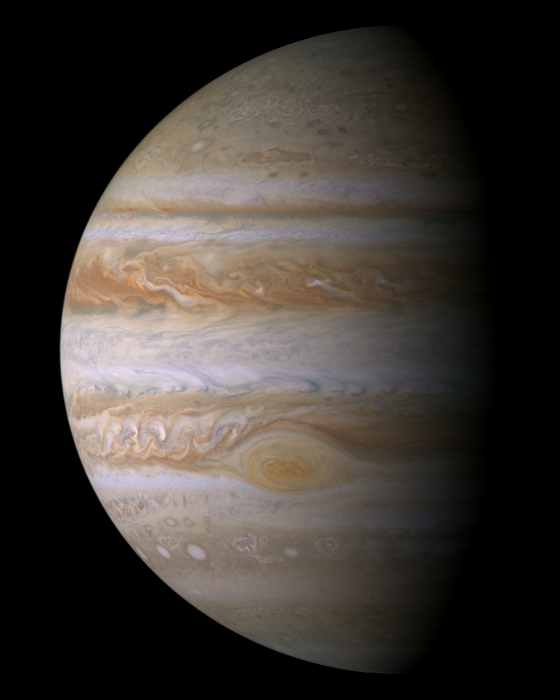
Figure eleven.11: Image of Jupiter from the NASA Cassini mission
If y'all look at some of the fine details in the image, you lot will not see anything that looks like the continents on Earth, the craters on Mercury, or the rocky plains of Mars. Instead, information technology looks more like the clouds of Venus, which obscure that planet's surface. Animations, such equally the Cassini movie of the Great Carmine Spot produced from images taken past the Cassini satellite, show that the visible atmosphere is in constant motility, and even appears to have about circular storms that practise non look all that different from hurricanes on Globe.
The atmosphere of Jupiter shows a lot of structure. It has alternating dark and lite colored bands, which are not polish, merely which contain swirls and eddies. One of the reasons for the banded structure in Jupiter's advent is that convection is occurring in the atmosphere. Convection occurs when you have a temperature deviation between the layers in a liquid or gas. The common case is putting foam in a cup of coffee—since the cream is colder than the coffee, it sinks to the lesser, where information technology heats upwards. Then, when information technology heats up, it rises to the top, where it cools off, and then sinks again. Then the process of convection creates a circular current in the fluid. This is going on in Jupiter'south atmosphere, and what we observe as the different colored bands are actually dissimilar layers in the atmosphere. The light-colored areas (called zones) are the bands that are ascension, while the dark-colored areas (called belts) are the layers that are sinking. Equally the "air" (the mix of gases that makes upwardly Jupiter'southward atmosphere, which is different than air on Earth) rises, clouds form out of different materials—water, ammonium hydrosulfide, and ammonia. The whitish zones are the loftier layers of ammonia clouds, while the darker belts are the lower layers of ammonium hydrosulfide clouds. The verbal cause of the colors remains an open up question for researchers. Inside the clouds, reactions between sunlight, lightning, and different chemic compounds probably give rise to the diversity of colors seen in Jupiter's temper, only exactly what processes give rise to which colors has not been adamant nonetheless.
Jupiter has been visited past several missions, the most recent being Juno. Juno passed very close to Jupiter, and, in particular, studied its polar regions. This mission revealed previously unknown details about Jupiter, similar every NASA Solar Organisation exploration does when it visits a world.
Only similar in the atmosphere of Earth, storms develop in the atmosphere of Jupiter. Unlike the Earth's atmosphere, however, some of the very big storms reach a level of stability that allows them to persist for hundreds of years, and maybe even longer. The most famous tempest in Jupiter's atmosphere is called the "Great Cherry-red Spot," which is a rotating tempest larger than the Earth! Here are some photos of this famous storm:
- APOD: The Peachy Red Spot
- APOD: The Swell Red Spot and the Smaller White Oval
- Hubblesite: Changes in the Peachy Cherry Spot
Smaller storms in Jupiter's atmosphere announced, disappear, merge, and modify in relatively short time scales. However, the Great Red Spot has persisted for at least 300 years. Information technology can be seen to change over fourth dimension. The Neat Red Spot has some similarities to hurricanes on Globe, with the principal difference being hurricanes are clockwise rotating, depression pressure storms, while the Great Red Spot is a counterclockwise rotating, high pressure storm. On Earth, when these storms hit land, they tin can lose energy quickly, and the storm volition dissipate. Since the Keen Blood-red Spot has not dissipated, this tells u.s. that (1) in that location is some source of free energy continually supplying it with plenty to remain stable, and/or (2) there is no solid land underneath it to crusade it to lose energy rapidly.
Although astronomers have no direct mode of observing Jupiter's interior, we have some evidence that suggests what it may be like. Although this planet is fabricated up primarily of hydrogen and helium, which are plant in gas form on World in normal conditions, the conditions in Jupiter's interior are unlike those on Earth. Given the temperature and pressure on Jupiter, we think that most of the planet is actually liquid hydrogen. What lies beneath this liquid layer is even more of a mystery. Nosotros expect that at that place may exist a small solid core (nigh the size of the Earth) at the very center of Jupiter that is made upward of rock, metals, and solid compounds of hydrogen.
If you remember our discussions of the night heaven, nosotros discussed how many of the planets are easily visible to the naked center. The inner planets do not emit whatever of their ain light. Instead, they are visible because they reflect sunlight. This is not strictly truthful for Jupiter. If yous measure how much total low-cal it emits, information technology is more than the corporeality of sunlight that reaches the planet. Like the persistence of the Great Blood-red Spot, which suggests some internal machinery is providing energy to the cloud layers, the fact that Jupiter is giving off more light than it receives besides suggests in that location is some internal energy generation. When nosotros discussed protostars, nosotros saw how they generated energy through gravitational contraction before nuclear fusion began. In the case of Jupiter, it does not contain enough mass to e'er achieve the internal temperature and pressure to begin nuclear fusion, but it can generate energy through gravitational contraction.
Source: https://www.e-education.psu.edu/astro801/content/l11_p5.html
0 Response to "What Is the Probable Source of the Day-to-day Variations in Jupiters Belts and Zones?"
Post a Comment