Leggings in a post-#MeToo world: Are they symbols of seduction or freedom?
When did leggings make the leap from garment to cultural lightning rod? For what are substantially stretchy footless tights in a seemingly countless array of patterns and colours, they have been an unexpected source of controversy.
Recently in Indiana, the Us, Maryann White, the female parent of iv sons, wrote a letter to The Observer, the school newspaper for both the University of Notre Matriarch and the nearby women'due south college St. Mary's, request female students to ignore way and stop wearing leggings. It was for their ain besides every bit the greater good, she suggested, in part because leggings made it hard for men to control themselves.
The you-wear-it/y'all're-asking-for-information technology implication of the letter, not to mention the sheer thought of censoring wearable, ready off the predictable firestorm of protest, both on campus and off. For 2 days students wore leggings in a bear witness of group defiance, at that place was a #leggingsdayND hashtag on Twitter, and assorted men and women posted pictures of themselves in solidarity with leggings wearers.
By the end of the week, The Observer had another piece, this 1 from the editors in response to the furore. It said: "Having received over 35 messages to The Observer, in addition to the endless verbal comments, tweets, memes and class discussions well-nigh Mon's letter, we have been astonished by the conversations the leggings piece has sparked." Meanwhile, those wider chat continued over the weekend.
This follows a 2022 United Airlines incident when ii teenagers who were "pass travellers" (a category that includes relatives of airline employees) were prevented from flight because they were wearing leggings. Observers complained, social media got up in arms, and the makers of leggings had a field day; Puma, for instance, jumped into the fray and burnished its image by offer a xx percent discount on leggings to anyone presenting a United ticket.
And that in turn punctuated the endless debate among parents and schools and students that can exist summed up as "leggings-are-not-pants/yep-they-are."
In full general this existential interrogation of the soul of a garment (because, really, that'south what information technology is) centres on women, women's bodies and the general discomfort with seeing too much of them, or believing y'all are.
That's certainly where White was going with her letter, and it'southward mostly the political offence used past those who are on the pro-leggings side: How dare yous charge me of dressing to seduce (an argument that has detail resonance in the era after #MeToo).
Merely leggings began their ascent to wardrobe domination with the appearance of comfort civilisation: The mail service-casual Friday plow-of-the-millennium move away from formality that picked upward steam with the rise of fleece-wearing hedge funders, the fall of Old Wall Street and the fetishisation of Silicon Valley's hoodies- and Teva-clad geniuses, and became even more pronounced under the influence of the Wellness movement.
The post-casual Fri turn-of-the-millennium move abroad from formality that picked up steam with the ascent of fleece-wearing hedge funders, the fall of Erstwhile Wall Street and the fetishisation of Silicon Valley's hoodies- and Teva-clad geniuses, and became fifty-fifty more pronounced nether the influence of the Wellness movement.
Leggings likewise function differently for different age groups: For Gen Y, they tend to be lifestyle signifiers that have more than to do with health and activity than, say, everyday workwear; for Gen Z-ers, who largely refuse uniformity and traditional labels, they are simply a basic, the equivalent of jeans. They are something y'all put on without idea.
Which is to say, leggings are about a lot of things, and sex may exist the least of them – if sexual practice plays any office at all.
One matter that was hit about the Notre Dame protestation was the rejection of what they saw as the traditional gender assumptions involved. Leggings are not the sole province of the siren female person was the thought.
In their editorial, The Observer'southward writers asked, "Why has the legging controversy generated a larger impact than other controversial topics? Students and community members have spent hours debating the merits and faults of a pop habiliment choice. But where is the willingness to speak up most other issues with substantial policy implications, legally and on campus?"
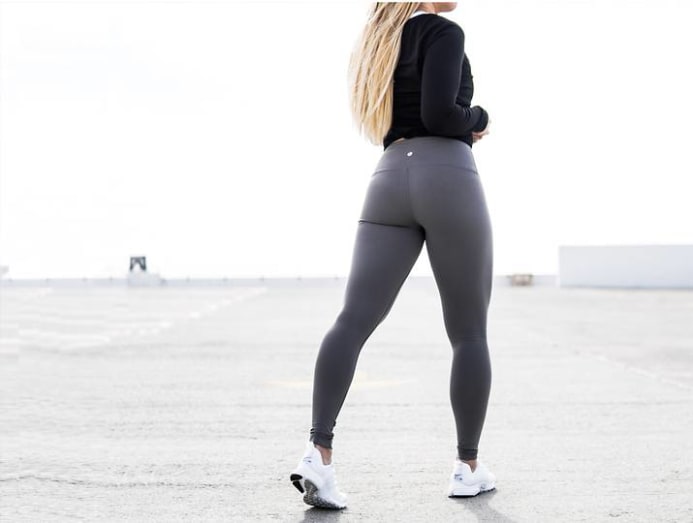
The truth is, it'southward possible leggings may be simply continuing in for those other problems. One of the cracking gotchas of fashion is that what may appear superficial or unimportant (leggings!) is, in fact, representative of a more complicated, harder to limited reality (identity). This is what gives clothes their ability.
As a upshot, what the leggings uproar may have exposed is not and so much anyone'south physique per se but rather a cultural fault line that runs through generations. This historical blueprint includes miniskirts and jeans, Mary Quant and James Dean, and garments that seemed egregious and inexplicable to what is more often than not referred to as the establishment but play a key and highly visual part in upending norms to make way for the side by side.
Sure, it's possible that is overstating the matter. Information technology'due south possible they are merely stretchy footless tights that are easy to wear.
Merely judging past Lululemon'southward recent results, which saw net revenue rise 21 percent in the third quarter of 2018, and the fact that part of Levi's much-heralded IPO was attributed to the "stretch" at present included in jeans to cater to the leggings market, this "popular clothing choice" (as The Observer labelled it) is not going away any time shortly. All this suggests that the Notre Matriarch uproar may not be a fluke but a harbinger.
For Gen Y, leggings tend to be lifestyle signifiers that accept more than to do with health and activity than, say, everyday workwear; for Gen Z-ers, who largely reject uniformity and traditional labels, they are merely a basic, the equivalent of jeans.
By Vanessa Friedman © 2022 The New York Times
READ> Yoga on YouTube: What to wait out for when following yogi Tim Senesi'southward videos
Source: https://cnalifestyle.channelnewsasia.com/obsessions/are-leggings-symbols-of-seduction-or-of-freedom-239556
0 Response to "Leggings in a post-#MeToo world: Are they symbols of seduction or freedom?"
Post a Comment